
THE LAND OF BODHISATTVAS CHINA’S FOUR SACRED MOUNTAINS
China, a vast and immense country with world-renowned scenic landmarks. Experience with Zenflower Travel a journey to the beautiful mountains that are the spiritual centers of the great Bodhisattvas in Mahayana Buddhism. This is a magnificent pilgrimage to discover an endless source of spiritual inspiration by following the vows of each Bodhisattva, such as Guanyin, Ksitigarbha, Manjusri, and Samantabhadra.
MOUNT WUTAI
The dwelling place of Bodhisattva Manjusri, the Bodhisattva who symbolizes the vast wisdom of all Buddhas. Mount Wutai is a mountain range consisting of five adjacent peaks, creating a stable formation like the wisdom of the Bodhisattva. The ancient temples and landmarks associated with the sacred sites of Bodhisattva Manjusri, such as Dailuo Ding, Xiantong Temple, Pusa Ding… all make those who seek Buddhist wisdom wish to come and pay homage at least once in their lives.
Mount Wutai is a refined convergence of temples combining the styles of Esoteric, Chan, and Pure Land Buddhism, connecting the profound teachings of Buddhism in the light of Bodhisattva Manjusri’s wisdom.
MOUNT EMEI
Mount Emei the bodhimanda of Bodhisattva Samantabhadra, has been hailed by many Chinese literati as the “most renowned mountain under heaven”. Its highest peak, Wanfoding, reaches 3,099 meters. It is said that Bodhisattva Samantabhadra, riding a six-tusked white elephant, roamed the human world. Upon arriving at Mount Emei and seeing its solemn and serene beauty, he preached the Dharma to save all sentient beings and manifested his boundless great vow
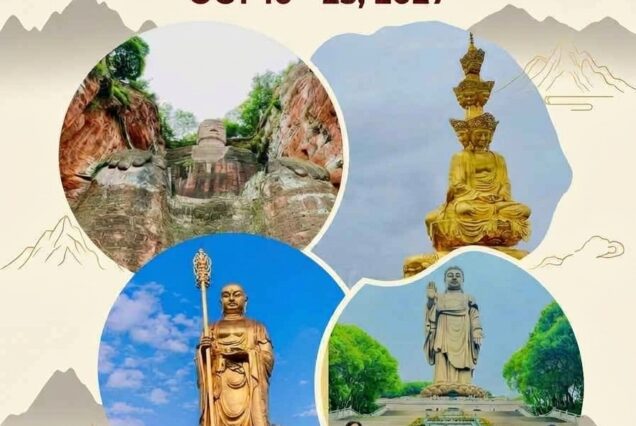
Atop Golden Summit, a magnificent statue of the ten-faced Bodhisattva Samantabhadra riding a six-tusked elephant now
stands, radiating splendor. This, along with the 71- meter-tall Leshan Giant Buddha, serves as a miraculous stop on the
pilgrimage route in China. All the religious architectural works here
MOUNT PUTUO
Also known as the “Buddhist Kingdom on the Sea,” it is the abode of Bodhisattva Avalokiteshvara (Guanyin), located in Zhejiang province, about 20 km from Ningbo city. The profound spiritual responsiveness of Bodhisattva Avalokiteshvara inspires millions of Buddhist pilgrims to journey to Mount Putuo every year. Paying homage to sacred sites related to the Bodhisattva’s manifestations on Mount Putuo, such as Fayu Temple, Puji Temple, and the Unwilling-to-Leave Guanyin Temple, and especially the 33- meter-tall Nanhai Guanyin statue along with the Five Hundred Arhats Hall, deeply moves the hearts of countless Buddhist devotees devoted to the Bodhisattva Who Hears theWorld’s Sounds
MOUNT JIUHUA
This is the sacred site of Bodhisattva Ksitigarbha, who made the great vow to save all sentient beings in the six realms before attaining Buddhahood. Mount Jiuhua is known as the Lotus Buddhist Kingdom, with a serene landscape, majestic mountains, and peaceful scenery. It bears the imprint of Bodhisattva Kim Qiao Jue, who was an incarnation of Ksitigarbha.
The Hundred-Year Palace, the Hall of the Preserved Body, H u a c h e n g Te m p l e , a n d Ksitigarbha Temple are the
sacred sites that pilgrims can visit and pay homage to when they come to Mount Jiuhua.
Sights

Map
Info
The pilgrimage to the Four Sacred Mountains is also subtly combined with visiting the 88-meter-tall Grand Buddha at Ling Shan in Wuxi city, and the 71- meter-tall Grand Buddha at Leshan in Leshan city.
Additionally, the program includes a visit to the world’s number one wonder, the Great Wall of China, and the Yonghe Temple in Beijing
Pilgrimage to China’s Four Great Sacred Mountains, 12 days and 11 nights, traveling entirely by plane with 2 international flights and 6 domestic flights.