I may never see the Vương father and son again, but that noble image will forever remain etched in my memory.
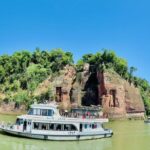
Mount Jiuhua is one of the four famous Buddhist mountains in China. It is the sacred sanctuary of Chan Master Kim Kiều Giác (Ksitigarbha), originally a Crown Prince of Silla (modern-day Korea). Legend says he was an emanation of Ksitigarbha Bodhisattva who came to Mount Jiuhua to propagate the Dharma in the seventh century.
Here, amidst hundreds of majestic, undulating green peaks, stands a magnificent 99-meter-tall statue of Ksitigarbha Bodhisattva, its golden body radiating a brilliant glow. A seemingly endless stream of pilgrims stretches for kilometers, coming to pay homage and prostrate before the Bodhisattva.
After worshiping and prostrating before the sacred image, our group found a patch of grass beneath the canopy of trees to sit in stillness, followed by a Dharma sharing session on the theme “The Virtue of the Earth.”
As the evening shadows lengthened, the group prepared to depart when we noticed a man in the distance laboriously carrying an elderly man on his back, his eyes fixed on a wheelchair stationed beneath a nearby tree.
Seeing this, Brother Trung Toàn hurried over to clear the wheelchair into an open space so the man could gently place the elder into it. I stood with palms joined, filled with a deep sense of admiration, thinking to myself that this must be a son carrying his father up Mount Jiuhua to pay homage to the Bodhisattva.
Sister Nguyên Giới walked over holding an envelope, opening her heart to the man: “Our group has a modest gift, consider it a few herbal medicines for the elder. Please kindly accept it.” The man smiled, waved his hand, and replied, “Just having the group’s care is already a great blessing. Thank you, sister; thank you to the entire delegation.”
With that, he turned toward me, placed his palms together, and bowed in farewell. The wheelchair gradually faded behind a cluster of foliage, the quiet trail fading in the slanting rays of the evening sun.
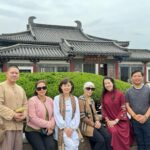
Our group lingered to take a few commemorative photos at the foot of the Bodhisattva statue before descending the mountain. After walking about a kilometer, the father and son unexpectedly appeared once more.
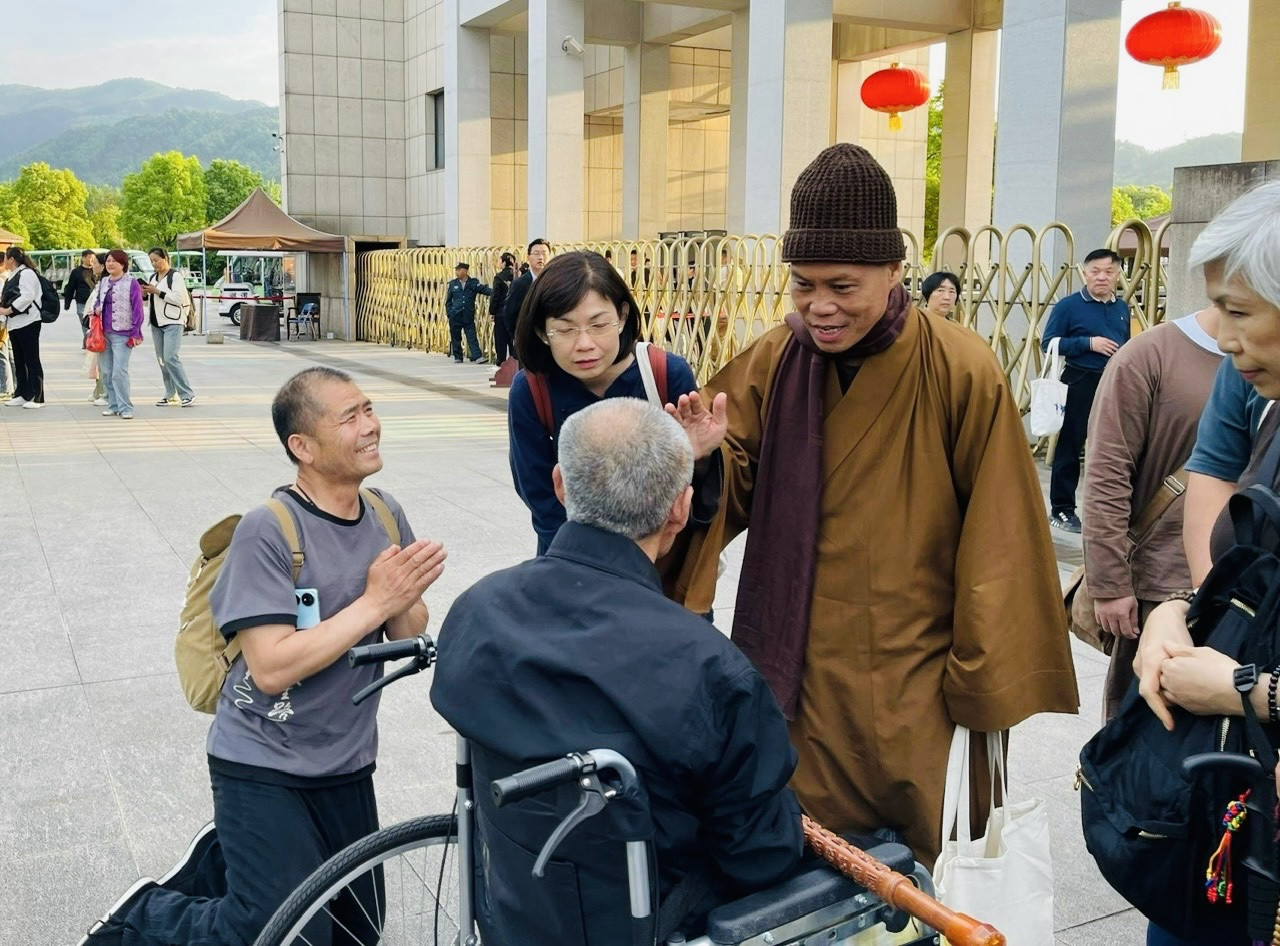
The man pushed the wheelchair right into the middle of the path and knelt before us, his palms joined and his heart overflowing with reverence: “Respected Master, my father is now in the autumn of his years. We beseech you to bestow a few words of Dharma guidance so that we may understand the true value of human life and live at peace for the remainder of our days.”
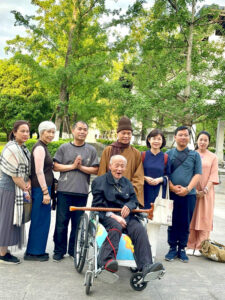
(People the author met on Mount Jiuhua)
An inexpressible wave of emotion welled up within my heart. I encouraged the elder to constantly abide in the awareness of impermanence, to see and know things as they truly are, recognizing that nothing is “self” or “mine,” and to practice the lifestyle of letting go: wealth, loved ones, expectations, regrets, joy and sorrow—all clinging to this mind and body.
Afterward, I guided the elder to take refuge in the Buddha, the Dharma, and the Sangha. As he took his final vows, I looked at the elder. Though his limbs could not move, a gentle smile graced his face, and he tried his best to nod in silent acceptance and expression of profound gratitude.
The man pushing the wheelchair was not the elder’s son, but his son-in-law. The elder in the wheelchair was his father-in-law, approaching eighty years of age. On the occasion of International Labor Day, the son-in-law had traveled with his father-in-law from Hubei, spanning a journey of over 500 kilometers, to visit Mount Jiuhua and revere Ksitigarbha Bodhisattva.
As I walked away, my mind kept drifting back to the noble image of that son-in-law. The expanse of Mount Jiuhua is vast and boundless; merely walking it exhausts the legs, yet this son-in-law had carried his father-in-law the entire way across winding, rugged terrain. Seeing the beads of sweat on his cheeks and hearing his labored breathing, my heart was filled with deep admiration.
Yet that was not all. When our group had walked about another 500 meters and was nearing the exit, the wheelchair of loving-kindness appeared once more. The son-in-law hurried toward me, holding an envelope in both hands as an offering. Before I could take it, he gently placed it into the bag I was carrying, bowed, brushed away his tears, and hurried off.
We all stood watching in overwhelming emotion. Sister Lệ Mai, who served as our interpreter, wiped her tears repeatedly, unable to speak a single word. She unclasped the bracelet from her wrist and ran to present it to the elder. Kiết Tường, Bá Khanh, and Như Ngọc quickly rushed to offer a string of amber beads to the man in the wheelchair.
Along the homeward path, we walked in quiet solitude, speaking no words, occasionally exchanging glances as though we had just lived through a fairy tale.
In this modern society, such radiant examples are rare. Filial piety toward one’s parents is hard to find; showing filial reverence to one’s father-in-law is even rarer; and possessing a sincere, unshakeable faith in the Triple Gem is rarest of all.
Though we did not have much time to converse and learn more about their family background, I imagine this must be one of the happiest families of our time. If his wife were here, I would tell her: “You have a great Bodhisattva right in your home—did you know?”
Through the way he joined his palms, prostrated, and made his requests, I knew for certain that the son-in-law must be a devoted Buddhist, perhaps even that their entire family shares faith and devotion to the Triple Gem.
If one were merely traveling for leisure, would a person endure such hardship and patience to bring their father-in-law over 500 kilometers to Mount Jiuhua, push the wheelchair, and carry him for kilometers around the mountain simply to worship Ksitigarbha Bodhisattva with such utter sincerity?
Without an understanding of the Dharma, how could he ask: “Master, please bestow a few words of guidance so we may understand the value of human life and live in peace for our remaining days”? And without faith, how could he generate the mind of offering with such pure reverence and devotion?
I may never see…
Tri Chon, Chiết Giang, ngày 06/05/2024
Source : vietnamnet.vn